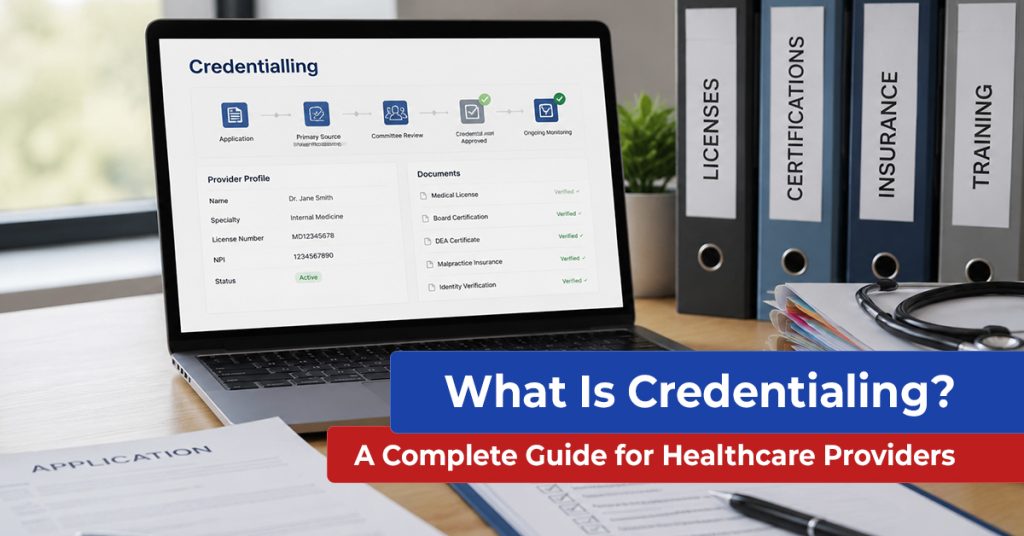
Blog Summary: Healthcare credentialing verifies a provider’s education, licenses, training, work history, and professional standing before patient care. The process includes primary source verification and checks with entities such as NCQA, CAQH, and NPDB. In 2026, credentialing teams must also track updated NCQA verification windows, including 120 days for Credentialing Accreditation and 90 days for Credentialing Certification.
Credentialing is the process of verifying that a healthcare provider is qualified and safe to treat patients. It involves reviewing education, licenses, work history, malpractice claims, and other professional records. These checks help healthcare organizations confirm a provider’s qualifications before permitting them to treat patients. For facilities and locum tenens staffing partners alike, credentialing is the first gate. It keeps patients safe. It keeps billing clean too. This guide explains the credentialing process, how it differs from privileging and payer enrollment, and what’s new in 2026.
What Is Credentialing in Healthcare?
Credentialing checks a provider’s school, training, licenses, and work history. Experts call this primary source verification, or PSV. It lets a hospital or health plan know the provider is safe to treat patients.
Credentialing is not a one-time check. It happens again each time a provider joins a new job. It also repeats on a set schedule after that.
During medical credentialing, a staff member checks:
- Medical school and residency training
- State license and DEA registration
- Board certifications
- Work history and any gaps
- Malpractice claims and insurance
- Any past sanctions
Each item gets checked at the source. Not from a copy the provider hands over. That is what makes credentialing different from a resume check. It is also why the work takes weeks, not days.
Why Does Credentialing Matter for Patient Safety and Revenue?
Credentialing protects two things. First, the patient. Second, the money. If a provider treats patients too soon, that is a risk. Most payers will not pay for care given before enrollment is done.
Credentialing also protects the facility. Say a provider hid a past claim. The credentialing file shows what staff checked. It proves the facility did its job. Or it shows where things went wrong.
How Does the Credentialing Process Actually Work?
The steps stay the same at most places. Only the speed changes.
- Application. The provider sends in their school, license, and work history. Many use a shared tool like the CAQH Provider Data Portal.
- Primary source check. Staff calls each school and board. They confirm every fact by hand.
- Background check. Staff check the National Practitioner Data Bank. They check the OIG list too. They look for red flags.
- Credentialing Committee Review. The credentialing committee reviews the verified file and approves, denies, or requests more information.
- Approval. Once approved, the provider joins the staff list. Privileging and payer enrollment come next.
- Recredentialing. Most places repeat this whole process every 36 months.
Missing paperwork is the top cause of delay. Staff cannot check what they do not have. Each missing form adds more wait time.
Privileging and Payer Enrollment
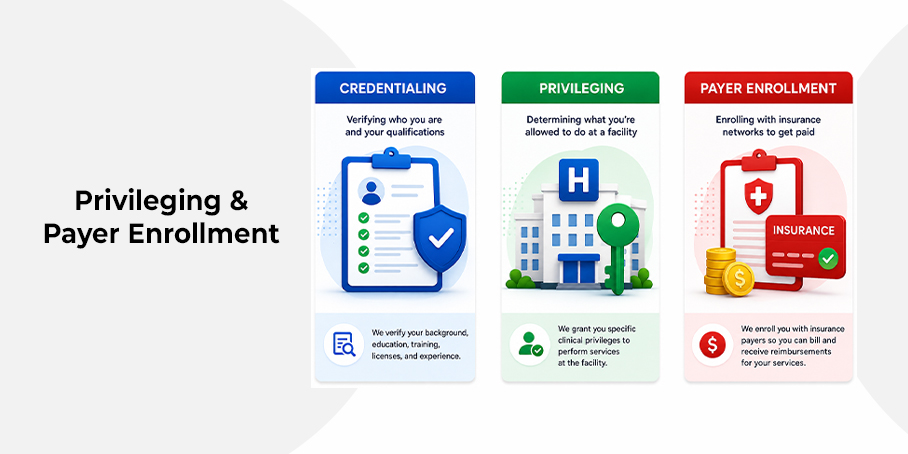
Three words get mixed up a lot: credentialing, privileging, and payer enrollment. Each one means something different. Credentialing checks who the provider is. Privileging sets what they can do at one place. Payer enrollment decides if the facility can bill for their work. A provider can pass credentialing. They still cannot treat patients or earn revenue until the other two steps are done.
Credentialing
This is the check covered above. It asks one thing. Do the license and history check out? It does not grant any tasks. It just proves the provider is real.
Privileging
Privileging sets the exact tasks a provider can do at one site. It is based on training and past skill. A surgeon may be credentialed at a hospital. They still need privileges for one specific surgery. Privileges do not move with the provider. A new hospital means a new privileging file.
Payer Enrollment
This step adds a provider to insurance plans. It covers Medicare and Medicaid too. Claims cannot be paid without it. This step is often the slowest. Each payer moves at its own pace. Most will not start until credentialing is almost done. A provider who works too soon risks losing every claim.
What Types of Credentialing Exist in Healthcare?
Credentialing looks different in different places.
- Hospital staff credentialing: Set by hospital bylaws. Checked by a staff committee.
- Health plan credentialing: Run by insurance firms. Often pulls data from CAQH.
- CVO credentialing: A third-party firm runs the checks for a hospital or plan.
- Locum tenens credentialing: Built for short-term providers. Must repeat fast for each new job.
- Delegated credentialing: A health plan lets a trusted hospital do the checks for them.
Providers who move often, like those weighing why work locum tenens fits their goals, may face more than one type of credentialing in a year.
What Mistakes Delay the Credentialing Process?
Most delays come from a short list of issues.
- Missing forms. A blank date or missing signature starts a slow back-and-forth.
- Old documents. An expired license copy puts a hold on the whole file.
- Missed CAQH dates. A skipped attestation can turn a profile inactive. That stalls every payer that uses it.
- Hidden claims. A hidden malpractice claim can trigger a full re-check later. It also hurts trust.
- Manual tracking. Spreadsheets lead to more missed dates than dedicated software does.
How Long Does Provider Credentialing Take in 2026?
Time depends on the facility’s status. It also depends on how complete the file is. And on how many payers are in the mix. New NCQA rules cut the check window. It is now 120 days for accredited groups. It is 90 days for certified groups. That is down from the old 180-day rule. Most hospital files still take 60 to 120 days start to finish. Payer enrollment can add 30 to 90 more days on top.
Providers who send a full file up front move faster. Fast replies help too.
What Tools and Standards Keep Credentialing Compliant?
A few groups set the rules in the U.S. The National Committee for Quality Assurance (NCQA) sets the main standard. Most health plans and CVOs measure against it. New rules from 2025 mean shorter check windows. They also mean monthly checks after approval. The Joint Commission sets rules for hospitals. This covers staff credentialing and privileging records. URAC sets rules for health plans and review groups. It also covers facilities like surgical centers. The CAQH Provider Data Portal is a shared hub for provider data. It was once called CAQH ProView. A provider fills it out once. Then they share it with the payers they pick.
Facilities that follow these four groups see fewer gaps. They also see fewer surprises at review time. Each group asks for the same core habits. Check at the source. Keep watching after approval. Write everything down.
Conclusion
Credentialing, privileging, and payer enrollment work as a chain. A provider needs all three to treat patients and earn revenue. Knowing where each step starts and ends helps set fair timelines. It also helps providers, including those looking into locum tenens work, send in full applications from day one. Facilities that need credentialed providers fast can work with a trusted locum tenens staffing partner to connect with locum tenens professionals across the country and handle the staffing side of the process.
Frequently Asked Questions
What is the difference between credentialing and licensing?
A state board grants a license. It says a provider can legally practice in that state. Credentialing is separate. Each hospital or plan checks that license, plus much more, before granting staff status.
Can a provider work before credentialing is complete?
Usually, no. Seeing patients too soon creates billing risk. Many payers will not pay for care given before enrollment starts.
How often does recredentialing happen?
Most places repeat the full check every 36 months. Monthly checks now run in between, under current NCQA rules.
Does CAQH replace the need for facility credentialing?
No. CAQH stores a provider’s data. Each hospital or payer still runs its own check. Each one makes its own final call.
What is medical staff credentialing?
This is the hospital-level check. It confirms a provider is fit to join the medical staff. It runs under the hospital’s own bylaws.