
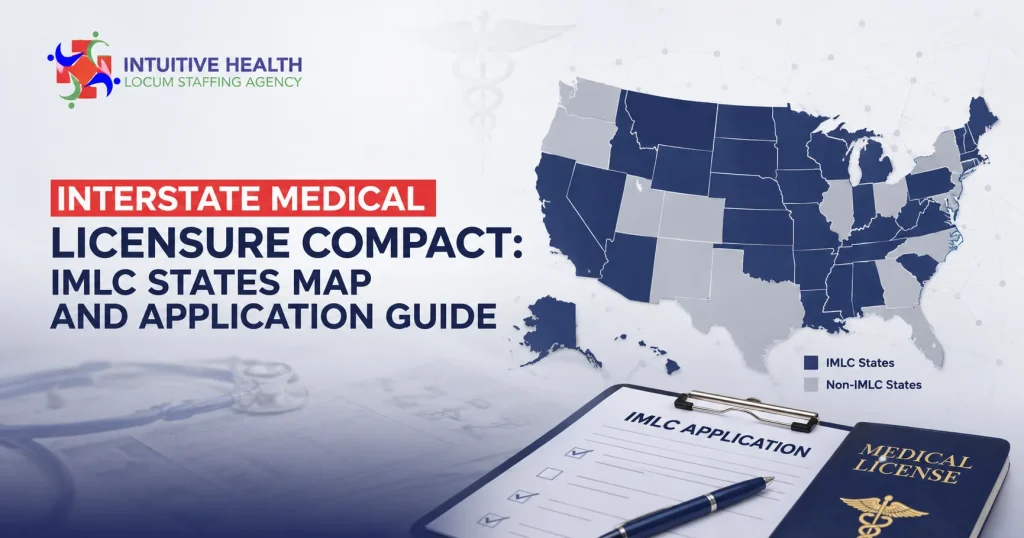
The Interstate Medical Licensure Compact (IMLC) is an agreement among 44 states, the District of Columbia and Guam that gives qualified physicians a faster route to licenses in more than one state. You apply once, your home state verifies you, and each state you choose issues its own license. It is not a national license. As of August 31, 2026, the compact reports 67,067 physician members and 233,959 licenses issued, per the snapshot on A Faster Pathway to Physician Licensure.
How Does the Interstate Medical Licensure Compact Work?
The Interstate Medical Licensure Compact makes it easier for physicians to get licenses in participating states, while each state keeps its own licensing rules and practice laws.
It Is an Expedited Pathway, Not a Multistate License
Physicians do not receive a compact license. Each state issues its own license under its own medical practice act, and you follow that state’s laws. The compact only routes your application through one shared process. According to the General FAQs, about 80% of U.S. physicians meet the criteria.
The Two Roles: State of Principal License and Licensing States
Your State of Principal License (SPL) is the member state where you hold a full, unrestricted license and which you name as your home base. It checks your credentials, runs the fingerprint background check and issues your LOQ. The other states you pick are licensing states, and they issue your licenses once they receive your LOQ. Member boards also share complaint information, so discipline in one state can trigger action in others.
Which States Are in the IMLC? Map and Full List
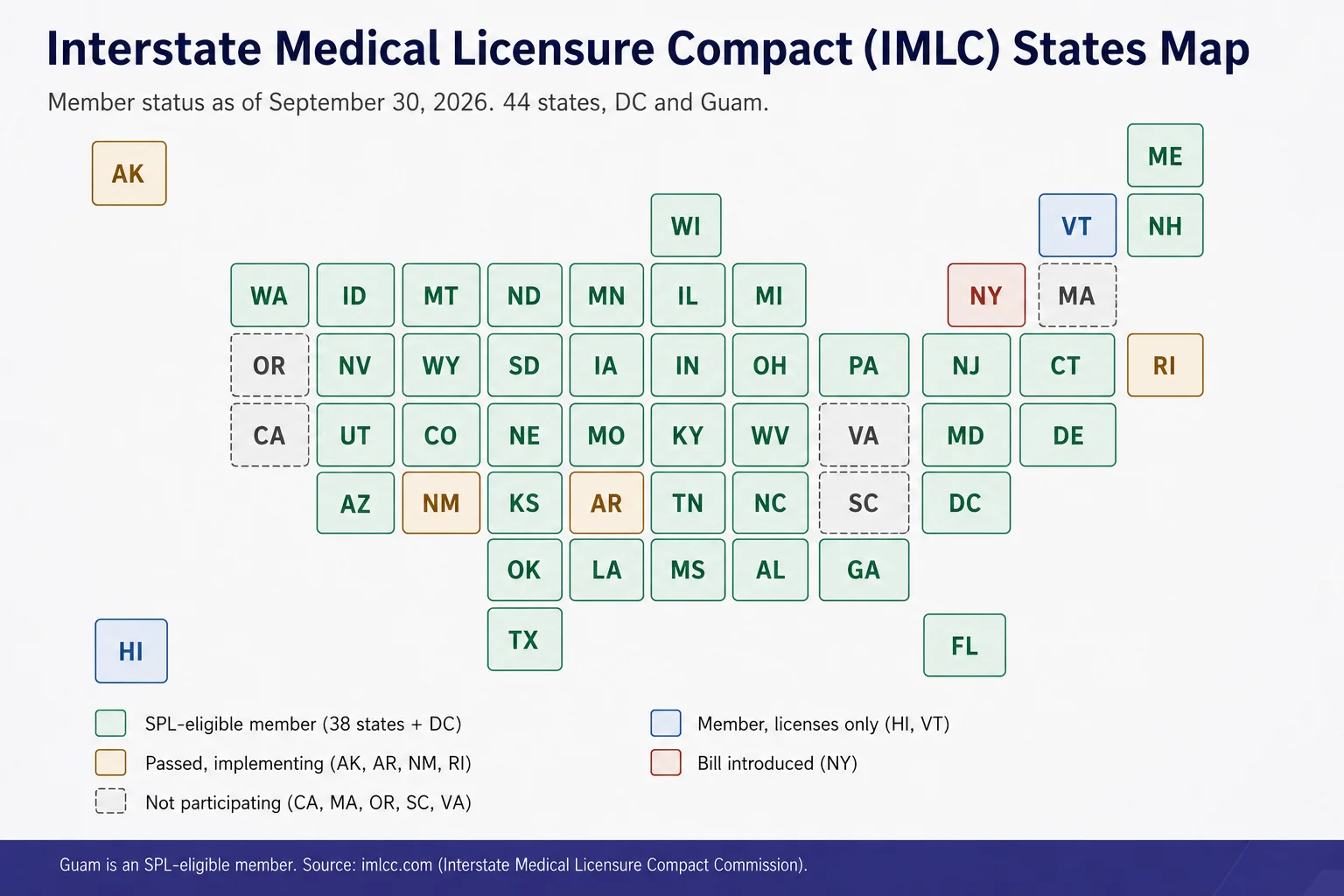
The table follows the IMLCC’s own map categories and reflects its homepage as of September 30, 2026. Alaska became the 44th member state in June 2026.
| Status | What it means | Jurisdictions |
| SPL-eligible member (38 states, DC, Guam) | Can be your SPL and issue licenses | Alabama, Arizona, Colorado, Connecticut, Delaware, Florida, Georgia, Idaho, Illinois, Indiana, Iowa, Kansas, Kentucky, Louisiana, Maine, Maryland, Michigan, Minnesota, Mississippi, Missouri, Montana, Nebraska, Nevada, New Hampshire, New Jersey, North Carolina, North Dakota, Ohio, Oklahoma, Pennsylvania, South Dakota, Tennessee, Texas, Utah, Washington, West Virginia, Wisconsin, Wyoming, plus DC and Guam |
| Member, licenses only (2) | Issues licenses but cannot be your SPL | Hawaii, Vermont |
| Passed, implementation in process (4) | Law passed, not fully live | Alaska, Arkansas, New Mexico, Rhode Island |
| Legislation introduced (1) | Bill filed, not a member | New York |
| Not participating | No bill listed on the map | California, Massachusetts, Oregon, South Carolina, Virginia, and U.S. territories other than Guam |
Two details trip people up. You cannot enter the compact through Hawaii or Vermont, though you can get licenses there. And the four implementation-in-process states cannot issue compact licenses yet, so ask the state board for a go-live date. Only a legislature can add a state, and the map shows no California bill, so a California license still requires a standard application. The live map sits on the Participating States page.
Who Is Eligible for the IMLC?
You qualify if you hold an unrestricted license in an SPL-eligible state and meet the compact’s education, exam, certification and clean-record rules, all detailed on the Information For Physicians page.
Qualify for a State of Principal License
Beyond the unrestricted license, at least one of these must be true in that state:
- Your primary residence is there.
- At least 25% of your practice happens there.
- Your employer is located there.
- You use it as your state of residence for federal income tax.
You must keep SPL status at all times. If you lose it and cannot redesignate (which is free), every compact license you hold is terminated.
Meet the General Requirements
You need an accredited medical school degree (or one listed in the International Medical Education Directory), ACGME- or AOA-accredited residency, and passing scores on each USMLE or COMLEX-USA component in no more than three attempts. You also need current or time-unlimited ABMS or AOABOS certification. You cannot have license discipline, a criminal history, controlled-substance actions on your license or an open investigation.
Where Physicians Get Turned Away
The Canadian LMCC exam does not satisfy the exam rule. Training outside the U.S. counts only if the program held ACGME or AOA accreditation while you attended. Living outside a member state is fine if you meet one of the four SPL tests. Check everything first, because the fee is non-refundable.
What Is an IMLC Letter of Qualification (LOQ)?
An IMLC Letter of Qualification is the document your SPL issues after verifying your credentials and completing your background check. It confirms you are eligible and lets you request licenses from other member states. It is not a license, and it does not let you practice anywhere by itself.
What the LOQ Does and Does Not Do
The LOQ unlocks the step where you choose states and pay each fee. It does not guarantee a license. A board can still ask for a jurisprudence exam, an online profile or proof of work authorization, and ignoring those requests can lead to action against the license.
How Long Is an LOQ Valid?
An LOQ is valid for 365 days, with no waivers. During that year, you can add states for a $100 handling fee plus each state’s license fee. After it expires, you reapply and pay the application fee again, but you don’t need to show board certification again. List every state you might need in year one.
How to Apply Through the IMLC, Step by Step
- Confirm eligibility using the rules above.
- Choose your SPL and start the application on imlcc.com. Use an email address you check daily, because every notice goes there.
- Pay the $700 application fee by credit card. The IMLCC posted a notice in June 2026 about a new card processing policy, so confirm your final total at checkout.
- Submit fingerprints. Your SPL sends instructions, and you have 60 days.
- Wait for your LOQ. TheIMLCC Member States handout puts the average at 30 to 45 days and says the SPL controls that pace.
- Select states and pay each state’s fee.
- Receive your licenses. The IMLCC says this usually takes a few days, while its handout cites an average of about 20 days.
- Answer each board’s follow-up requests, then renew each license through the IMLCC’s Renew function.
IMLC Fees and Processing Timelines
What Does the IMLC Cost?
Your total is $700 plus the license fee for each state you choose. All fees are non-refundable, and renewal costs are set by each board. The What Does it Cost? page (last modified May 1, 2026) lists every state, and the spread is wide.
| Group | Initial license fees listed |
| Lowest | Pennsylvania M.D. $35, Missouri $102, Wisconsin $120, Utah $200 |
| Highest | Texas $895, D.C. $805, New Jersey $805, Nevada M.D. $800, Maryland $790 |
Three low-fee states (Pennsylvania M.D., Missouri, Wisconsin) total $257 in state fees, or $957 with the compact fee. Three high-fee states (Texas, New Jersey, Nevada, M.D.) total $2,500, or $3,200. State fees, not the compact fee, drive your budget. These totals exclude renewals and extra board requirements.
How Long Does the IMLC Take?
Plan on roughly seven to nine weeks, adding the IMLCC’s 30 to 45-day LOQ average to its roughly 20 day average for state licenses. Some boards are faster. The Texas Medical Board’s Interstate Medical Licensure Compact Application page says it processes applications in about 15 business days. Your SPL sets the pace for the first phase and each licensing state the second, so finish fingerprints early. That is the step you control.
Benefits and Limitations of the Compact for Physicians
The main benefit is efficiency: one application, one portal for payments and no repeated verification for every state. The limits are real, though:
- It only reaches member states, so California and New York need standard applications.
- The $700 is non-refundable and costs the same whether you add one state or twelve.
- Losing your SPL ends every compact license.
- Licensing is separate from hospital privileging, payer enrollment and any state-controlled-substance or DEA requirements.
IMLC vs. Nurse Licensure Compact vs. PA Compact
The three compacts share a goal but work differently, so a staffing team with mixed clinicians should not treat them as interchangeable.
| Profession | IMLC | Nurse Licensure Compact | PA Compact |
| Covers | Physicians (MD/DO) | RNs and LPN/VNs | Physician assistants |
| What you receive | A separate license from each state | One multistate license from your home state | A compact privilege in each state |
| Administered by | IMLCC | National Council of State Boards of Nursing | PA Compact Commission |
The PA Licensure Compact site lists its member states, and the NCSBN publishes the official NLC map. Membership changes often, so check both, including whether PA privileges are being issued yet.
How the IMLC Helps Locum Tenens and Traveling Physicians
The IMLC can simplify multistate licensing for physicians who move between assignments or provide care across state lines. It offers an expedited pathway while each state maintains its own licensing requirements and practice rules.
Build Your State Portfolio Inside One LOQ Window
Locum physicians often chase assignments in several states in a year. Adding states within the 365-day window avoids a second $700 payment. New to this path? Our guide on why physicians choose locum tenens work explains the appeal.
Telehealth: License Where the Patient Is
Under the compact, medicine is practiced where the patient is located, and that state’s laws apply. A telehealth physician needs a license in each state where patients sit.
What Credentialing Coordinators Should Check
The LOQ is not proof of licensure. Verify each license with its issuing board, confirm the physician’s SPL is current and track renewals state by state.
Ready to Put Your Licenses to Work?
Once your licenses are in place, the next step is finding assignments that match them. Browse current physician roles on the Intuitive Health Services job list. With the right licenses in place, you can explore opportunities across multiple states and find assignments that fit your specialty, schedule, and career goals.
IMLC FAQs
Is the IMLC a national medical license?
No. Each state issues a separate license. Nor can it cover all 50 states, since it reaches only member states.
Is Florida part of the Interstate Medical Licensure Compact?
Yes. Florida is SPL-eligible, and both its M.D. and D.O. boards appear on the fee list at $355 and $305.
Is Hawaii a compact state?
Yes, with limits. Hawaii issues licenses through the compact but cannot serve as your SPL.
Why is California not in the IMLC?
California’s legislature has not enacted it, and the IMLCC map shows no bill there. Use the standard application.
Can I use the IMLC if I live in a non-member state?
Yes, if you hold an unrestricted license in an SPL-eligible state and meet one of the four SPL tests.
Is the IMLC worth it?
It tends to pay off when you need several member-state licenses, because the $700 is fixed. For one state, compare its direct application fee with $700 plus its compact license fee.