
Internal medicine is a growing specialty. The demand for internists continues to rise as chronic diseases become more common and healthcare needs become more complex.
This guide explains what internists do, their daily responsibilities, training requirements and career paths. Whether you’re exploring the specialty or looking for your next opportunity, partnering with the best healthcare staffing agency can help you find locum tenens and permanent internal medicine positions that align with your career goals.
What Does an Internist Do?
An internist is a physician who specializes in preventing, diagnosing and treating diseases in adults. Internists manage acute illnesses, chronic conditions, preventive care, and complex medical cases while coordinating treatment with other specialists when needed.
Understanding the Role of an Internist
An internist is a doctor for adults, they do not treat children. Family medicine physicians treat patients of all ages, while internists focus exclusively on adult health, from short-term illness to long-term disease and preventive care.
Many patients have more than one problem at once. A patient may have diabetes and heart disease at the same time. Where a cardiologist treats just the heart, an internist looks at the full picture and treats the whole person.
Is an Internist a Primary Care Physician?
It depends on the setting. Many internists work as primary care physicians, seeing the same patients year after year, managing chronic disease, and serving as the first point of contact for adult health concerns. Others work only in hospitals as hospitalists, never running an outpatient clinic at all. Still others complete a fellowship and specialize further after residency, narrowing their focus to a single organ system or disease area.
The split generally comes down to outpatient versus hospital-based practice:
- Outpatient internal medicine looks like traditional primary care, scheduled visits, ongoing relationships, and long-term disease management in a clinic setting.
- Hospital-based internal medicine (hospitalist work) involves caring for admitted patients during acute episodes, often in shift-based schedules with no long-term follow-up.
Both paths fall under the internal medicine umbrella, but they suit very different working styles and lifestyles.
Core Responsibilities of an Internist
Internists do many jobs each day. Here are the main ones:
- Diagnosis. Find the cause of a symptom.
- Prevention. Screen for risks early.
- Chronic care. Manage long-term issues like diabetes.
- Treatment plans. Build a plan based on full history.
- Med checks. Watch for drug interactions.
- Team care. Work with other doctors.
- Test review. Read lab results.
- Records. Keep clear patient notes.
Additional Responsibilities
Beyond the daily basics, internists are also expected to:
- Diagnose complex, overlapping conditions that don’t fit a single textbook picture.
- Interpret laboratory and imaging results in the context of a patient’s full history.
- Coordinate multidisciplinary care across specialists, therapists, and care managers.
- Manage patients with multiple chronic diseases simultaneously.
- Develop long-term treatment plans that adjust as a patient ages or their condition changes.
- Provide preventive screenings tailored to age, risk factors, and family history.
- Optimize medications to avoid overlap, interaction, or unnecessary polypharmacy.
- Educate patients on disease management so they can take an active role in their own care.
A Day in the Life of an Internist
No two days look the same, but most follow a similar rhythm. The morning often starts with hospital rounds or a full clinic schedule. An internist may check on inpatients first, reviewing overnight labs and adjusting treatment plans before the next shift takes over. Then outpatient visits begin. A single day might include a wellness check, a diabetes follow-up, and a new patient with unclear symptoms that need real investigation.
Between visits, there is often a steady flow of messages. Lab results come in. A specialist calls back about a shared patient. A pharmacy flags a possible drug interaction. Each of these needs a quick, careful decision.
Documentation happens throughout the day, not just at the end. Most internists chart as they go, since notes support both patient safety and accurate billing.
The pace can shift fast. A routine visit can turn into an urgent case within minutes. That mix of steady routine and sudden change is part of what makes the specialty demanding, and part of what many internists find rewarding. No single day fully captures the job, but the constant thread is this: an internist is often the one person tracking a patient’s full health picture over time.
Common Conditions Internists Treat
Internists regularly diagnose and manage a wide range of adult conditions, including:
- Diabetes
- Hypertension
- COPD
- Heart disease
- Asthma
- Kidney disease
- Arthritis
- Thyroid disorders
- Obesity
- High cholesterol
- Infections
- Osteoporosis
Because so many of these conditions overlap in the same patient, much of an internist’s value lies in managing them together rather than in isolation.
Where Internists Practice
Internists work in many places, and each setting feels different:
- Hospitals. Care for patients who are admitted.
- Clinics. See patients for regular visits.
- Private practice. Run a smaller office.
- Academic centers. Treat patients and teach students.
- Community centers. Serve patients with less access to care.
- Telemedicine. See patients online.
- Government clinics. Work for public health.
- VA hospitals. Care for veterans.
- Concierge care. See fewer patients and spend more time with each one.
Education and Training Pathway
It takes many years to become an internist. Here is the path:
Bachelor’s Degree (4 years): Most students take pre-med classes, biology, chemistry, and physics.
Medical School (4 years): Students earn an MD or DO. The first two years are in class; the last two years are hands-on.
Internal Medicine Residency (3 years): New doctors train in hospitals and clinics, seeing harder cases each year. This follows ACGME rules.
Medical Licensure: Doctors must pass an exam; MDs take the USMLE, DOs take the COMLEX, then obtain a state license.
Board Certification (ABIM/AOBIM): After residency, doctors take board exams to meet national standards: the ABIM for MDs, or the AOBIM (American Osteopathic Board of Internal Medicine) for DOs.
Optional Fellowship (1–3 years): Some doctors train further in a single area to subspecialize.
Is Internal Medicine the Right Specialty for You?
Internal medicine tends to suit physicians who:
- Enjoy solving complex cases. Many internal medicine patients present with overlapping, sometimes ambiguous symptoms that require real diagnostic reasoning.
- Like long-term patient relationships. Especially in outpatient settings, internists often follow the same patients for years or even decades.
- Are interested in lifelong learning. Guidelines, medications, and best practices shift constantly, and internists are expected to keep up.
- Are comfortable with teamwork. Coordinating with specialists, nurses, and care managers is a daily part of the job.
- Enjoy evidence-based medicine. Internal medicine leans heavily on current research and clinical guidelines rather than procedure-based work.
Internal Medicine Subspecialties
Many internists pick one focus area after residency. Each area treats a different part of the body:
- Cardiology — the heart
- Endocrinology — hormones, like insulin
- Gastroenterology — the stomach and gut
- Hematology — the blood
- Oncology — cancer
- Pulmonology — the lungs
- Rheumatology — joints and immune cells
- Infectious disease — hard-to-treat germs
- Nephrology — the kidneys
- Geriatrics — older adults
- Critical care — ICU patients
- Sleep medicine — sleep issues
Each of these requires additional fellowship training, adding one to three years. It often means higher pay but a narrower focus. Some internists skip this step entirely and stay in general practice.
How to Choose a Subspecialty
Picking a subspecialty is a personal decision. There is no single right answer, but a few questions can help.
Ask what kind of problems you enjoy solving. Some internists like fast-moving, high-stakes cases. Others prefer long-term relationships built over years. Both styles fit different subspecialties well.
Think about lifestyle too. Some fields, like cardiology, can mean more call hours. Others, like endocrinology, tend to offer steadier daytime schedules. Neither is better, it depends on what fits your life right now.
Look at the job market in your area. Some subspecialties are in high demand in certain regions and harder to find work in others. A conversation with a mentor or a physician career resource can help you see real, local trends before you commit years to extra training.
Finally, be honest about your energy for more school. A fellowship is a real investment of time. It can pay off, but only if the fit is right. There is no risk-free choice here, just an informed one.
Skills Every Successful Internist Needs
Good internists need more than facts; they also need these clinical and interpersonal skills.
- Clinical thinking. Turn symptoms into a clear answer.
- Communication. Explain problems in plain words.
- Leadership. Guide a care team.
- Teamwork. Work well with nurses and other staff.
- Time skills. Balance many patients each day.
- Flexibility. Adjust to new tools and rules.
- Judgment. Weigh choices with care.
- Research use. Apply new studies to real cases.
- Tech skills. Use health records well.
- Ongoing learning. Keep skills fresh over time.
Career Opportunities for Internists
Internal medicine offers many paths:
- Hospital work. Steady shifts as a hospitalist.
- Group practice. Share costs with other doctors.
- Academic medicine. Mix care with teaching.
- Telehealth. Treat patients from afar.
- Concierge care. See fewer patients for a fee.
- Locum tenens. Take short jobs in new places.
- Leadership. Become a medical director.
- Research. Work on clinical trials.
- Admin work. Help run a hospital.
Many internists mix two or more paths. Staffing firms, like Intuitive Health Services, help internists find open internal medicine jobs, including full-time and locum tenens positions.
Permanent vs. Locum Tenens: What to Weigh
Many internists face this choice at some point. Neither path is safer or riskier than the other, both come with trade-offs worth knowing upfront.
A permanent role often means steady income and long-term patient relationships. It also usually means benefits, like retirement plans and paid leave. The trade-off is less control over schedule and location.
Locum tenens work offers more freedom. You choose where and when you work. Pay is often higher per shift to offset the lack of benefits. It suits internists who want to explore new regions, fill a gap between jobs, or simply try a new setting before committing.
Some internists use locum work early in their career to test different practice types. Others turn to it later, after years in one role, for a change of pace. There is no wrong choice, the right one depends on your goals, your finances, and the season of life you are in.
Salary and Employment Outlook
According to the U.S. Bureau of Labor Statistics Occupational Outlook Handbook: Physicians and Surgeons, physicians and surgeons held approximately 839,000 jobs in 2024. General internal medicine physicians are included within this occupational category.
National average compensation. Internist pay varies widely by source and region, but general internists typically fall in the mid-to-high six figures annually, with subspecialists often earning more after fellowship training.
Hospital vs. outpatient salary. Hospital-employed internists and hospitalists often see more predictable, shift-based pay, while outpatient or private-practice internists may have more variable income tied to patient volume, payer mix, and practice ownership.
Rural vs. urban differences. Rural areas frequently offer higher base pay or sign-on incentives to offset physician shortages, while urban centers may offer lower relative pay but greater access to academic and specialty opportunities.
General internist vs. subspecialist. Subspecialists, cardiologists, gastroenterologists, oncologists, and similar, generally out-earn general internists, reflecting the additional fellowship training and narrower, often procedure-inclusive scope of practice.
Locum tenens earning potential. Locum tenens assignments often pay a higher per-diem or per-shift rate than comparable permanent roles, since they don’t include benefits like retirement contributions or paid leave.
Factors affecting compensation:
- Location: Pay differs by state and by city versus rural area.
- Setting: Hospitals and clinics may pay differently.
- Time in practice: Pay tends to rise over time.
- Focus area: A fellowship can raise pay in some fields.
- Local need: Areas with fewer doctors may pay more.
Demand looks strong. The AAMC expects a shortage of up to 86,000 U.S. doctors by 2036. Primary care is hit hard, and as more people age, the population over 65 is projected to grow by more than one third by 2036.
Trends Shaping Internal Medicine in 2026
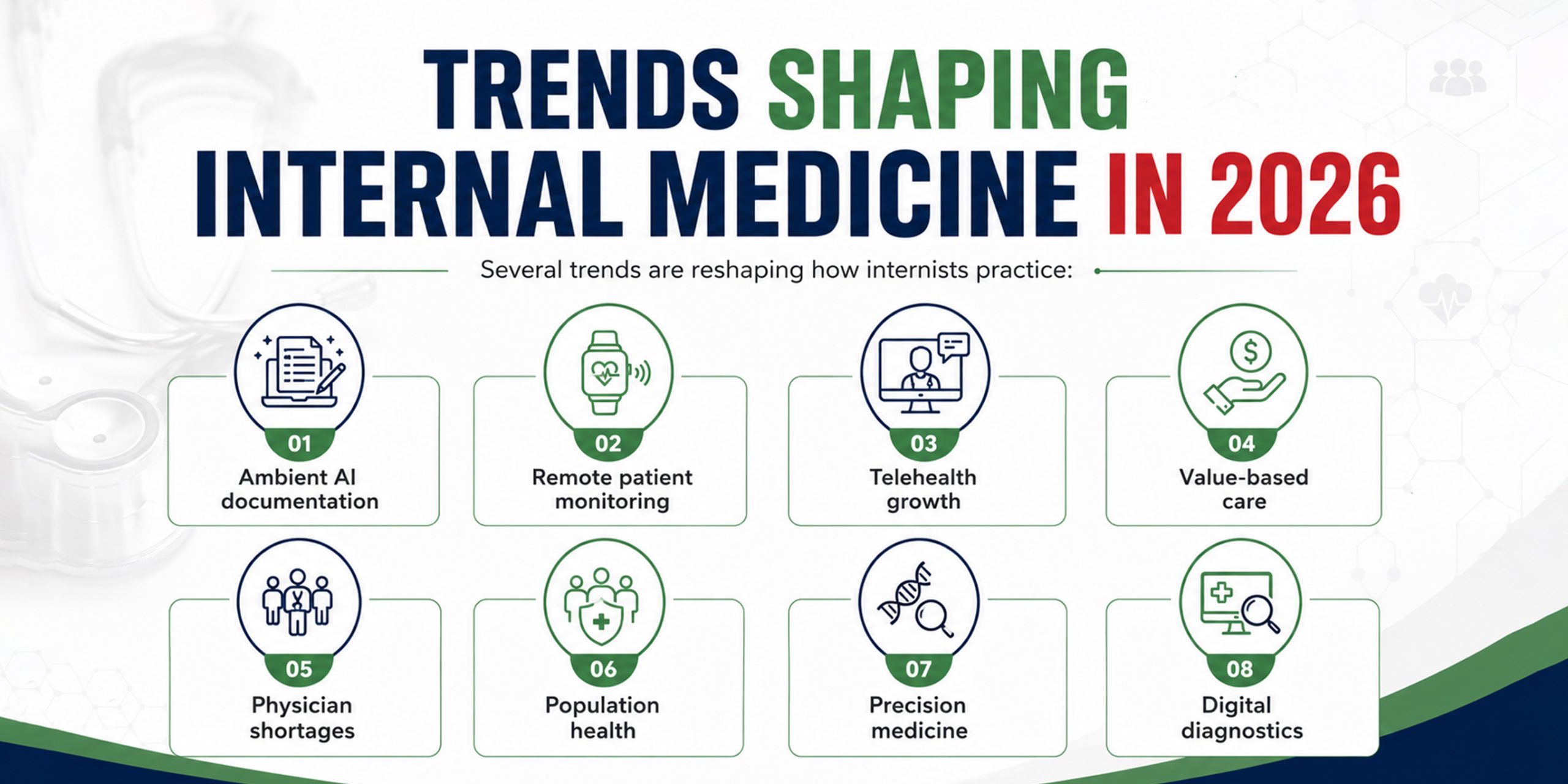
Several trends are reshaping how internists practice:
- Ambient AI documentation. AI-powered tools that listen to visits and draft notes automatically are reducing time spent on charting.
- Remote patient monitoring. Connected devices track chronic conditions like blood pressure and glucose from home, feeding data back to the care team.
- Telehealth growth. Virtual visits remain a permanent fixture, especially for chronic disease follow-up.
- Value-based care. Compensation increasingly ties to patient outcomes rather than visit volume alone.
- Physician shortages. Ongoing shortages, especially in primary care, are increasing demand for both permanent and locum tenens internists.
- Population health. Care models now look at outcomes across whole patient panels, not just single visits.
- Precision medicine. Genetic and biomarker data are starting to guide individualized treatment decisions.
- Digital diagnostics. AI-assisted imaging and lab interpretation tools are becoming standard second checks in diagnosis.
Common Challenges and Rewards of Internal Medicine
Challenges:
- Hard cases with many parts.
- Heavy paperwork.
- Risk of burnout.
- Ongoing training to stay certified.
Rewards:
- A wide mix of problems to solve.
- Long-term bonds with patients.
- Freedom to work in many places.
- Many paths for growth.
- A real, lasting impact on health.
Quick Comparisons
Internist vs. family doctor. Internists treat adults only. Family doctors treat all ages. Internists often see harder cases; family doctors work in general clinics.
Internist vs. hospitalist. A clinic-based internist sees the same patients over time. A hospitalist works inside a hospital, seeing patients for a short stay. Clinic hours are set; hospital shifts can rotate.
Primary care vs. internal medicine. Primary care covers basic needs. Internal medicine covers basic care plus complex, long-term disease. Primary care serves all kinds of patients; internal medicine often serves adults with more than one health issue.
General Internal Medicine vs. Subspecialty Practice: General internists complete a 3-year internal medicine residency and diagnose, treat, and manage a wide range of adult medical conditions across multiple organ systems. Physicians who pursue an internal medicine subspecialty complete an additional 1 to 3 years of fellowship training to develop expertise in a specific area, such as cardiology, gastroenterology, or endocrinology. General internal medicine offers broader diagnostic variety, while many subspecialties often provide higher earning potential.
Conclusion
Internal medicine is a dynamic and rewarding specialty that offers physicians the opportunity to build long-term careers in a variety of practice settings. From primary care and hospital medicine to subspecialties, research, and leadership roles, internists play a vital role in delivering comprehensive adult healthcare.
As the demand for internal medicine physicians continues to grow, so do the career opportunities available across the healthcare system. Whether you’re beginning your career after residency or seeking your next professional opportunity, exploring Internal Medicine Jobs can help you find a role that aligns with your skills, interests, and long-term career goals.
Common Questions Physicians Ask Before Choosing Internal Medicine
Is Internal Medicine Competitive?
Match competitiveness varies by year and applicant pool, but internal medicine residency has historically been more accessible than some surgical or highly specialized specialties while still requiring strong academic performance, strong clinical evaluations, and a competitive residency application.
Is Internal Medicine a Stressful Specialty?
Like most clinical specialties, internal medicine comes with challenges such as high patient volumes, complex medical cases, documentation requirements, and care coordination. Many internists improve work-life balance by choosing practice settings that align with their career goals, whether outpatient clinics, hospital medicine, academic practice, or locum tenens assignments.
Can Internists Perform Procedures?
Yes. General internists commonly perform basic bedside and office procedures, such as joint injections, skin biopsies, and other minor procedures, depending on their practice setting and training. More advanced procedural work is typically performed by subspecialists, such as cardiologists or gastroenterologists.
Do Internists Work in Intensive Care Units (ICUs)?
Some internists do. Physicians who complete additional fellowship training in critical care medicine often manage critically ill patients in the ICU. General internists without critical care training typically collaborate with ICU teams rather than independently managing intensive care patients.
Can Internists Become Hospitalists?
Yes. Hospital medicine is one of the most common career paths after completing an internal medicine residency. Many internists work exclusively in hospitals as hospitalists, providing inpatient care without completing an additional fellowship.
Is a Fellowship Required After Internal Medicine Residency?
No. Completing an internal medicine residency qualifies physicians to practice as general internists. Fellowship training is optional and is only required for physicians who want to pursue subspecialties such as cardiology, gastroenterology, endocrinology, nephrology, or pulmonology.